Revenue operations was built to make a defined process run reliably. It's now being asked to change what people do, which is a different skill and a different job.
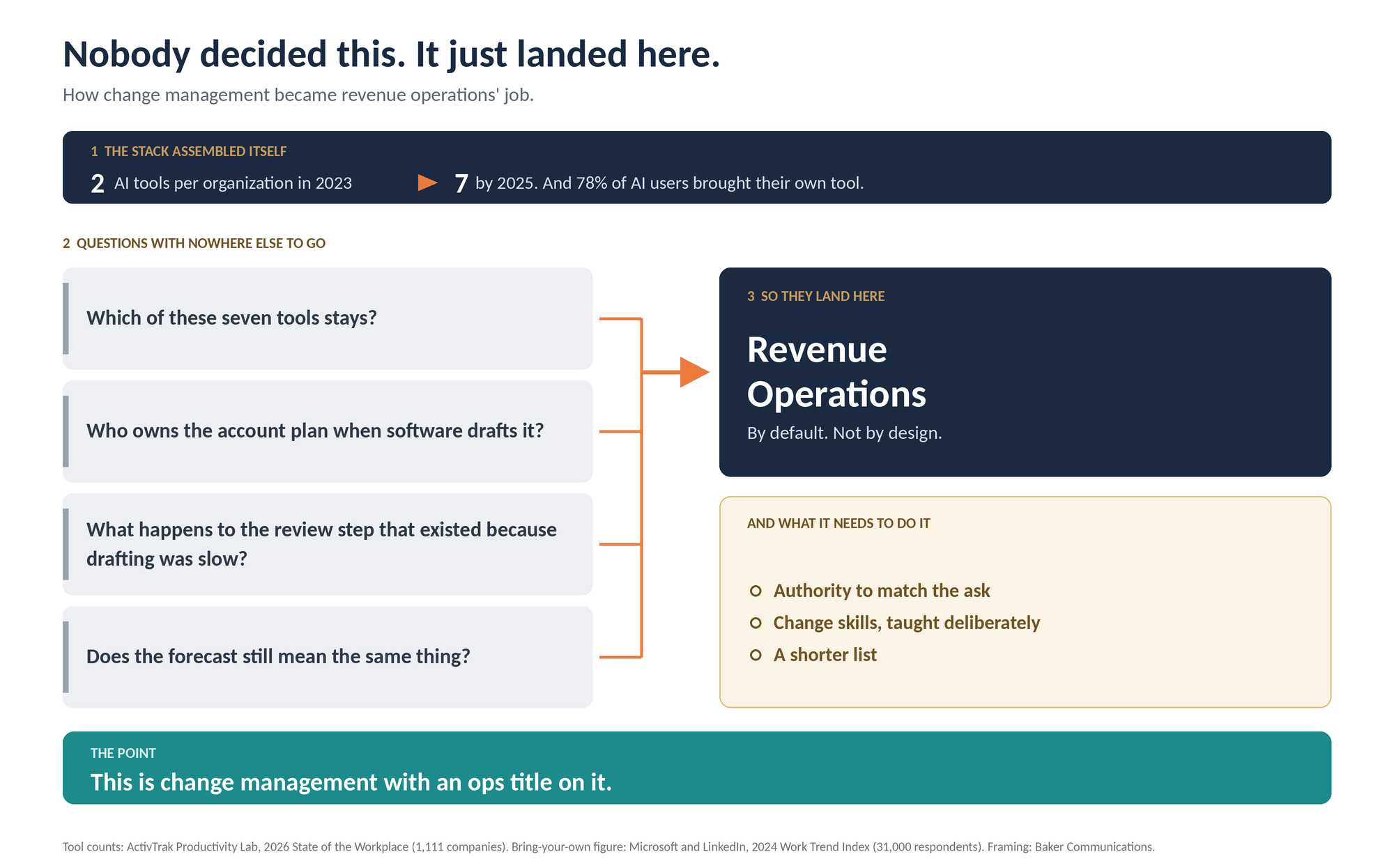
The average organization ran two AI tools in 2023. By 2025 it ran seven, with 83% running six or more. That's ActivTrak's analysis of activity across 1,111 companies1.
Most of them weren't bought centrally. Of the knowledge workers already using AI at work, 78% brought their own tool, according to the Work Trend Index from Microsoft and LinkedIn, 31,000 respondents across 31 countries2.
So a stack assembled itself. And the questions it raised landed on the function that owns the systems, because there was nowhere else for them to go.
The questions arriving now aren't operations questions. They look like this. Which of these seven tools stays. Who owns the account plan when software drafts it and a rep edits it. What happens to the review step that existed because drafting was slow. Whether the forecast still means the same thing when the inputs are generated.
Those are decisions about how people work. Answering them well takes a different set of skills than keeping a CRM clean, and most of the people in the role have been trained for the second thing.
It's also a bigger job than it looks. 89% of organizations have updated fewer than half of their roles to reflect what AI can now do, per Workday's survey of 3,200 leaders and employees3. Every one of those unrevised roles is a workflow somebody has to redesign, and the redesign has to hold up in front of the people who do the work.
| What The Function Was Built For | What's Landing On It Now |
|---|---|
| Keep the CRM clean | Decide which tools are allowed near it |
| Report the forecast | Redesign the workflow the forecast comes from |
| Administer the systems | Say who owns a workflow once software sits in it |
| Roll out a defined process | Get an organization to work a new way |
| Answer what happened | Decide what should happen instead |
Everything in the right column is change management. It involves persuasion, sequencing, and getting people to give something up, and none of it is in the job description.
Three things. Only one costs money.
There isn't good data on how far this role has shifted. The Revenue Operations Alliance is running a skills survey on that exact question and has said openly that nobody has measured it properly.
Which means the people in the role are navigating a change with no benchmark to point at. If you lead one of these teams, there's no industry standard to hand them for what the job is now. You write it with them or they guess.
Ask whoever runs revenue operations for you to list every AI tool currently touching the revenue process, including the ones nobody approved.
Then ask two follow-ups. Which of these would you turn off tomorrow if the decision were yours. And what would you need from me to make that call stick.
The second answer is usually about authority rather than information, and it tends to be the faster thing to fix.
The tools arrived faster than the operating model. The questions they raised landed on revenue operations because there was nowhere else to put them, not because anyone decided that was the right home. This is change management with an ops title on it.
Name the job accurately. Give it the authority the work needs. Take something off the list.
Up Next: The Output Stopped Being the Evidence
The same shift is happening one level down, in a place that's harder to see.
When a rep drafted their own account plan, a manager could coach the thinking by reading the work. Now the work might be mostly generated, so reading it tells you less. The question moves from was this done well to was this the right call, and whether the rep could tell the difference. The next post covers what to coach when the output isn't the evidence anymore.
Read the Next Post →Sources
Numbered citations throughout this article draw on the sources above.
