Coaching has always run on the work. When the work is mostly generated, it stops carrying much information about the person who made it.
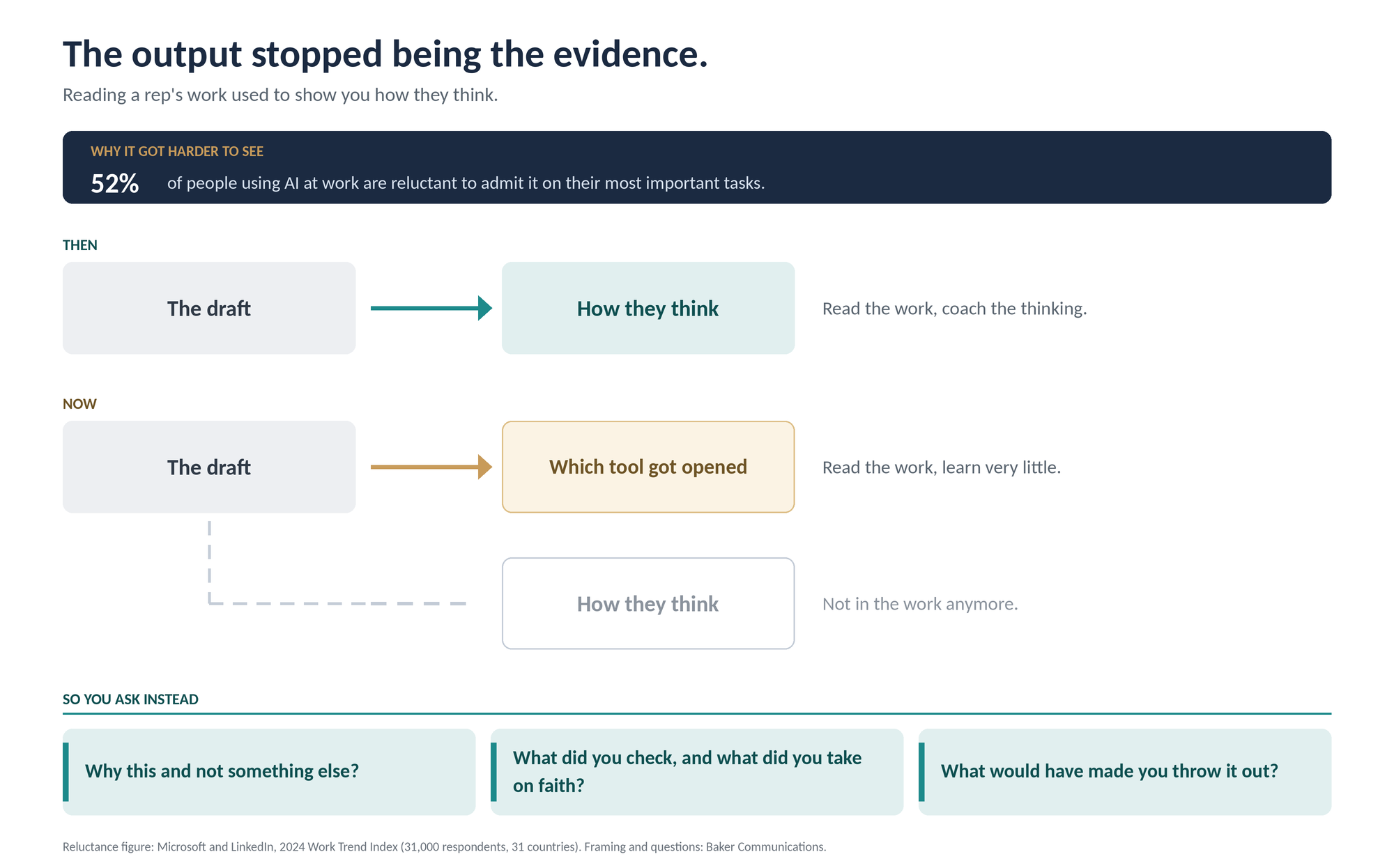
A manager reads the account plan, the follow-up email, the call notes. From the work you can usually see the thinking, and the thinking is what you coach. That has been the mechanism since managers started managing sellers.
When a draft takes twenty minutes instead of an afternoon, the link between the work and the person weakens. The document still tells you something. It just tells you less about judgment and more about which tool got opened.
One number complicates this. 52% of people using AI at work are reluctant to admit using it for their most important tasks, and 53% think using it makes them look replaceable. That's the Work Trend Index from Microsoft and LinkedIn, 31,000 respondents across 31 countries1.
So on exactly the work you would most want to coach, about half a team is quiet about which part was theirs. Nobody is being dishonest. They're managing a risk, and the risk is real enough that half of them feel it.
Meanwhile the skill that has become most valuable is the one hardest to see in a finished document. 77% of daily AI users review its output at least as carefully as a colleague's work, per Workday's survey of 3,200 leaders and employees2. That reviewing is real skill. It leaves no trace in the work, so it goes uncoached and unrewarded.
The old question was is this any good. These three replace it, and they take about twenty minutes on a real piece of work.
| Coaching The Draft | Coaching The Decision |
|---|---|
| Is this any good? | Why this and not something else? |
| Read the work, mark it up | Ask what got kept and what got cut |
| Correct the output | Correct the standard behind it |
| Praise the polish | Praise the call, including the ones nobody sees |
| Evidence is the work itself | Evidence is what they can explain |
Most managers haven't been taught to run this conversation, and the training gap is measurable. Two thirds of leaders call skills training a top investment priority, and barely a third of the people carrying the most AI rework say any of it has reached them2.
Skill isn't the only obstacle. A manager asking what did you take on faith has to be willing to answer it themselves. If the same manager forwards generated summaries without reading them, the question lands as an inspection rather than coaching, and the team will answer accordingly.
None of this is a new skill. Analytical thinking remains the most sought-after core skill among employers, with seven in ten calling it essential, according to the World Economic Forum's Future of Jobs report drawing on over 1,000 companies3. Judgment was always the job. It has stopped being visible in the deliverable.
Pick one piece of AI-assisted work that already went out. Sit with the rep who sent it and ask them to walk you through three things: what they kept, what they cut, and what they nearly used and decided against.
Then say what you would have done differently, and why. Skip that half and the exercise is an audit. Include it and the rep leaves with a standard to measure against.
The work used to be the evidence. Reading it harder won't bring that back.
What replaces it is a conversation about choices. Ask what got kept, what got cut, and what got checked. A rep who can answer those three is thinking. A rep who can't is forwarding.
Up Next: Two Teams, One Motion
The same collapse is happening between functions, not just inside a role.
Marketing used to own the message and sales used to own the conversation, and the handoff between them was a real boundary with real handoffs crossing it. When both sides can generate collateral, personalize at volume, and research an account in minutes, the boundary stops describing anything. The next post covers what happens to the handoff, who owns the message when both teams can write it, and why the org chart is usually the last thing to notice.
Sources
Numbered citations throughout this article draw on the sources above.
